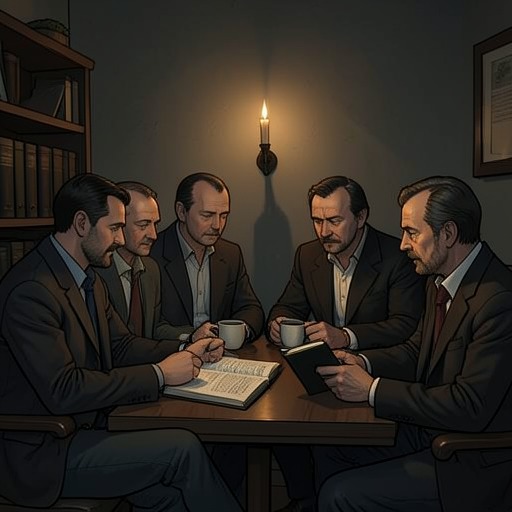
Léon Giraud
Illusions perduesLéon Giraud is the philosophical and political theorist of Le Cénacle, a tireless thinker whose convictions do not prevent friendship across profound differences. He judges ideas by rigorous argument, but his greater distinction is the way he listens: among his companions, disagreement becomes a form of assistance rather than a contest for superiority. His warnings to Lucien de Rubempré, his ideal of a responsible press, and his later critical support for Lucien’s novel make him a measure of the intellectual integrity the novel sets against ambition and faction.
Identity and Intellectual Work
Giraud is introduced as a profound philosopher and bold theorist, a worker who takes systems apart, judges them, expresses and formulates them, then lays them at the feet of his governing ideal, Humanity. Even his errors are ennobled by the good faith with which he pursues them. He is both an indefatigable worker and a conscientious scholar, and the account of his later life presents him as the founder of a moral and political school whose value, the narrator observes, only time can determine.
His convictions send him along a path different from those taken by his companions, but do not sever his attachments to them. That distinction is central to his portrait: ideas matter intensely to Giraud, yet they do not become a pretext for treating people who disagree as enemies. His intellectual ambition is collective in the best sense. He wants to formulate principles and put them to use, while remaining open to the judgment and work of others.
Le Cénacle and a Practice of Disagreement
Giraud belongs to a circle of nine whose members include Daniel d'Arthez, Michel Chrestien, Fulgence Ridal, and Joseph Bridau. Their beliefs diverge sharply. Daniel d'Arthez supports monarchy; Michel Chrestien dreams of a European federation; Giraud’s philosophical positions draw mockery from Fulgence Ridal, while Giraud himself predicts the end of Christianity and the family. Michel Chrestien, a believer in Christ as the divine legislator of equality, defends the immortality of the soul against Horace Bianchon’s analytic skepticism. These differences are not smoothed away: they are brought into conversation without becoming personal quarrels.
The companions share their work and consult one another with a sincerity the narrative associates with youth. When a serious question arises, a person arguing from one position can temporarily enter a friend’s ideas and help with a matter outside his own convictions. Giraud’s place in this arrangement makes his theoretical force compatible with impartiality. The group lacks the envy and vanity that would turn talent into rivalry; each member can receive help as readily as give it. Their material poverty contrasts with the abundance of their intellectual life, and they make even practical hardship a subject for friendly humor. Giraud’s model of intellectual community is therefore not agreement, but a disciplined generosity that allows disagreement to improve thought.
Reading Lucien de Rubempré
Giraud is among the first to identify a fault line in Lucien’s character. When Lucien’s feelings toward the circle come under discussion, Giraud acknowledges that he has not concealed them and is still frank, but fears that one day he will come to dread his companions. The concern is not that Lucien lacks talent; the circle already sees the promise of a great writer in him. It is that exposure to honest judgment may eventually become intolerable to someone drawn toward a different kind of success.
Michel Chrestien sharpens the warning by describing Lucien’s capacity to rationalize actions opposed to the group’s principles. Daniel d'Arthez fears that Lucien will conduct splendid arguments within himself only to arrive at blameworthy actions, never reconciling what he thinks with what he does. Giraud’s earlier reservation belongs to this broader forecast: the circle recognizes that Lucien may remain intellectually brilliant while becoming morally divided.
Later, Giraud interprets Lucien’s passion in similarly consequential terms. He describes love as a fire thrown into the vast domain of Lucien’s brain, which has set it alight; Joseph Bridau offers a less destructive possibility, that love has exalted Lucien beyond the friends’ sight. The competing interpretations leave the outcome unsettled, but they show Giraud treating passion not as a decorative romance but as a force that can alter a mind and its direction. His attention remains with the consequences of Lucien’s choices, not merely their surface glamour.
A Journal Governed by Principle
When Lucien suggests that journalism may be the only way he can support himself, Giraud answers with grave seriousness. He imagines a journal in which neither truth nor justice is violated and useful doctrines are spread for the benefit of humanity. The proposal is a direct expression of his philosophical commitments: journalism should serve more than its proprietor, faction, or audience. Its legitimacy depends on what it does to public understanding and justice.
Lucien immediately predicts that such a paper will have no subscribers. Michel Chrestien counters that five hundred subscribers of the right kind could be worth five hundred thousand, and Daniel d'Arthez says the necessary resource is not capital but devotion. Giraud’s scheme is thus tested against the economics of the press before it can become a practical undertaking. His companions defend its moral possibility, while Lucien understands the commercial obstacle. The exchange exposes the distance between journalism as public service and journalism as a means of making a living—a distance that will shape Lucien’s subsequent choices.
Giraud is not sheltered from the practical demands of publication. At the time of Lucien’s social and professional ascent, he is occupied with bringing out the first issue of his own review. His labor gives the ideal a concrete form: rather than only condemning compromised journalism, he is attempting to build an alternative. Yet his presence at Lucien’s gatherings also registers the growing separation between the two worlds. When friends of Lucien arrive for an evening of gambling and entertainment, Giraud is absent, occupied with the review; three members of the circle attend, and their serious, constrained expressions contrast with the company’s self-congratulation.
Warning, Loyalty, and Critical Afterlife
After Lucien announces his intention to join the royalist press, Giraud accompanies Daniel d'Arthez and Michel Chrestien in visiting him. The visit is not a congratulation: Daniel makes clear that, given Lucien’s earlier attacks on liberals, the Romantics, and the government, a sudden move into the royalist camp would stain his character. Giraud then explains the larger political danger. Royalist papers founded as retaliation for liberal attacks would answer injury with injury, normalize personal abuse, and strengthen the very press practices they claimed to oppose. Since subscribers were predominantly on the Left, he argues, the numerical advantage would favor the liberal press; the royalist writers could be branded enemies of the people while their opponents claimed the mantle of patriotism and martyrdom.
Giraud also traces the possible public consequences: reciprocal abuse could make restrictive laws and censorship seem necessary, while convincing the French public that the Bourbons meant to attack the material gains of the Revolution. In that case, the political response could be the expulsion of the Bourbons. His warning is both ethical and strategic. He objects to the means Lucien is about to adopt, but also shows how those means can produce consequences contrary to the cause they supposedly serve. Lucien answers that his reasons belong to a higher order of thought and that the end will justify everything. The exchange makes the gap between Giraud’s account of responsibility and Lucien’s appeal to results explicit.
Giraud’s loyalty survives this breach. During Lucien’s grave illness, Daniel d'Arthez entrusts Bianchon with the secret of Lucien’s royalist move and justifies the unfortunate poet to him; Bianchon then cares for Lucien. Giraud’s role in that act is not specified, but his later literary intervention provides a clear record of continued support. The novel that had failed commercially—the book of The Archer of Charles IX—regained value in 1824 after Daniel d'Arthez’s preface, the work’s own merit, and two articles by Giraud. Barbet, who had held back his copies rather than sell them at a ruinous discount, eventually sold them one by one for ten francs. Giraud’s criticism thus helps reverse the book’s degradation in the market. His career in the story joins conviction to work: he warns Lucien against turning principles into convenient arguments, builds a review around an alternative ideal, and later gives serious literary judgment where commercial failure had threatened to settle the matter.